When a high-temperature winding design lands on an engineer’s desk, the first friction is rarely the physics — it’s the paperwork. One supplier’s datasheet references MW 16-C. Another references IEC 60317-46. They look like they describe the same wire, but the labels don’t line up, and the thermal-class numbers don’t always agree either.
The real question isn’t “which standard is right.” It’s whether these two references point to comparable wire, how far you can trust a “Class 240” rating, and what you need to confirm before that specification carries your sign-off. This guide provides the framework engineers can use to reconcile the two references and evaluate the correct specification path.
When Engineers Consider Class 240 Polyimide Magnet Wire
The obvious instinct, when a winding is running close to its thermal limit, is to reach for the highest thermal class available. But is Class 240 the right answer here, or just the biggest number on the shelf?
Polyimide is commonly used in high thermal-class round copper magnet wire applications, and in the IEC system an aromatic polyimide enameled round copper wire carries a temperature index of 240. That makes it a strong candidate for demanding thermal environments — but a higher class widens your design margin, it doesn’t automatically make a wire correct for a given machine. Reaching for Class 240 without checking whether the rest of the design calls for it is a common way to over-specify.
During specification review, engineers generally work through this in a consistent order: understand what the standards on the datasheets actually refer to, compare the adjacent thermal classes against the design’s real thermal duty, watch for the misunderstandings that quietly produce the wrong choice, verify the supplier documentation, and only then commit to a wire they can defend to a reviewer. The sections below follow that same path.
MW 16-C and IEC 60317-46: How These Standards Relate
Two datasheets, two different standard references, one decision to make: can these be treated as the same kind of wire, or is this apples to oranges? Before you can cross-reference confidently, it helps to know why two labels exist for what is, at the material level, the same construction. Get that wrong and you either reject a perfectly good wire or, worse, assume an equivalence the standards don’t actually grant.
MW 16-C and IEC 60317-46 refer to comparable aromatic polyimide insulated round copper magnet wire specifications under different standard systems. They are not two names for one identical document, and one does not automatically satisfy the other — but for this material, they point an engineer toward the same kind of wire.
Why engineers see two different designations
The two labels exist because magnet wire is specified under different standards frameworks in different parts of the world. In practice, a North American supplier will typically reference MW 16-C, the designation from the American ANSI/NEMA MW 1000 standard, while an international supplier will reference IEC 60317-46, the corresponding part of the international IEC 60317 series.
Same material, two documentation traditions. When datasheets arrive from suppliers in different regions, in many cases you are not looking at a different wire construction, but at the same type of insulation system referenced through different standards frameworks. What you need is a reliable way to map one to the other, which is what the rest of this section provides.
What IEC 60317-46 covers
IEC 60317-46 is the IEC 60317 part that covers Class 240 round copper winding wire insulated with a single aromatic polyimide enamel coating. Within the IEC system, Class 240 pairs a temperature index of 240 with a defined heat-shock requirement, and the part is applied together with the base standard IEC 60317-0-1, which sets out the conductor diameter ranges.
In practice, this tells you what to expect on an IEC-referenced datasheet and what to ask for when comparing suppliers: the standard part number, the grade, and the conductor dimensions covered. A datasheet that cites “IEC 60317-46” without a grade is a datasheet you’ll want to send back with a question.
What MW 16-C designates
MW 16-C is a NEMA designation used for aromatic polyimide insulated round copper magnet wire. North American reference guides cross-reference MW 16 (round) to IEC 60317-46 for comparable polyimide material. That cross-reference is what lets you map an MW 16-C datasheet to an IEC 60317-46 specification when reconciling documentation — as long as you treat it as a mapping to confirm rather than an automatic equivalence.
Reading the two side by side
Why this comparison matters. When a datasheet arrives, you don’t want to be hunting through a standards library to work out what the reference means. The table below is the cross-reference an application engineer keeps close — not just the designations, but the reason each one turns up in the first place.
| Reference system | Designation (this product) | Why engineers use this reference |
|---|---|---|
| IEC 60317-46 | QY-*/240 (QY-1/240 = Grade 1, QY-2/240 = Grade 2) | The international specification reference; what you’ll see from suppliers documenting to IEC. |
| ANSI/NEMA MW 1000 | MW 16-C | The North American supplier-documentation reference; common on datasheets from US-based producers. |
What engineers should notice. The material lines up cleanly — aromatic polyimide enamel, round copper conductor, and a high thermal-class position. The one thing that doesn’t always line up is how the thermal class is named, and that deserves its own discussion, coming up shortly.
Class 200 vs Class 240 Magnet Wire: How Engineers Select Thermal Grade
Why isn’t the highest thermal class always the right choice? If Class 240 exists, why not simply specify it every time and stop worrying? Because a thermal class is a rating, not a ranking. Class 200 and Class 240 aren’t “good” and “better” — they’re two valid classes serving different design requirements, and defaulting to the highest one is a design decision made by reflex rather than analysis.
What a thermal class actually tells you
A thermal class is a temperature index: an evaluated rating of the insulation’s thermal endurance, defined within the IEC/UL framework. Class 200 wire carries a temperature index of 200; a polyimide Class 240 wire carries a temperature index of 240.
The point that trips people up is that the index classifies the insulation material’s thermal life — it’s a selection input, not a promise about your specific machine. Reading “240” as “runs at 240 °C” is the single most common error in magnet wire selection, and it’s worth being precise about it, which the next section does.
Engineering Insight
A higher thermal classification does not automatically mean a better winding design. The correct selection depends on whether the insulation system matches the complete application environment — the class number is one input to that judgment, not the conclusion.
The design considerations that actually drive the choice
Different thermal classes exist for different design requirements, and in practice the class you specify should follow from a handful of design realities rather than the temperature reading alone. A common consideration is the winding’s hotspot temperature and duty cycle — a machine that pushes thermal limits under sustained duty is where a higher-class polyimide wire earns its place, whereas a design sitting comfortably inside a Class 200 system has no inherent reason to move up. Alongside that sit the overall insulation system’s class and the design margin the reliability targets demand.
The decision is a system decision. The wire’s class has to be consistent with the class of the insulation system around it, so the winding is neither the weak link nor needlessly over-specified. Engineers often need to weigh those factors together rather than reading a single number off a table.
How to verify the choice
Before the selection is settled, it’s worth confirming it against the documentation rather than intuition. During specification review, that means checking the winding’s expected hotspot temperature and duty against the insulation system’s rated class, confirming the reliability margin, and considering what the termination, processing, and chemical-exposure conditions ask of the enamel. Those answers point to a class — sometimes 200, sometimes 240, occasionally something in between — instead of defaulting to the highest available.
Common Misunderstandings About Class 240 Thermal Classification
What does “Class 240” actually promise — and what does it quietly not promise? Most specification errors around Class 240 come from reading the “240” as a simple operating temperature. It isn’t, and three misunderstandings account for most of the trouble. Clearing them up is often what separates a defensible specification from a risky one.
It does not mean continuous operation at 240 °C
The temperature index is an evaluated classification of the insulation’s thermal endurance — not a guarantee that the wire may run continuously at 240 °C in your application. The IEC framework is explicit that the degrees-Celsius figure behind a temperature index is not, by itself, the recommended service temperature: the temperature a wire can actually be used at depends on the equipment and application it sits in. In practice, the permissible operating temperature is a property of the whole design, not of the class number.
A standard designation does not replace application validation
A wire correctly built to MW 16-C or IEC 60317-46 meets the requirements of that standard — but meeting a wire standard is not the same as validating the wire in your winding. Standard conformance qualifies the material; it does not qualify your finished insulation system, your processing, or your machine. Application validation stays with the engineer, and that’s not a formality — it’s where a material that looks right on paper either earns its place or doesn’t.
A higher thermal class is not automatically the safer choice
Stepping up to Class 240 isn’t universally safer. A higher-class enamel can behave differently in mechanical handling, processing, and termination, and the correct choice is the class that fits the design’s requirements and insulation system — not the highest one available. Over-specifying carries its own costs and processing consequences.
A note on Class 220 vs Class 240 labels
In specification review, engineers occasionally find that similar polyimide wire isn’t labeled with the same thermal-class number from every source. Different standard systems can use different thermal-classification conventions, so a class label on one datasheet won’t always read the same as on another. The right response is to verify the applicable standard designation and the supplier’s documentation — not to assume two labels are directly interchangeable, and not to assume a mismatch means two different wires.
How Polyimide Magnet Wire Supports High-Temperature Winding Reliability
What is it about polyimide, specifically, that holds up when a winding runs hot? “High temperature” on a marketing line means little without the tested properties behind it. What supports reliability is a combination of thermal endurance, heat-shock resistance, and cut-through resistance — verified by test, not asserted. For Jingda’s Class 240 polyimide wire, these are defined in the product specification and its referenced IEC test methods.
The thermal properties that matter, and their tested values
Why this comparison matters. Each of these properties maps to a specific stress the insulation sees in service, so it’s worth reading them not as isolated numbers but as answers to “what happens when the winding is worked hard.”
| Property | Tested value | Test basis |
|---|---|---|
| Temperature index (thermal class) | 240 (minimum) | IEC 60172 method; verifiable by UL |
| Heat shock | No cracking at 240 ± 5 °C, 30 min; minimum heat-shock temperature 260 °C | IEC 60851-6, clause 3 |
| Cut-through (softening breakdown) | No breakdown at 500 °C for 2 min | IEC 60851-6, clause 4 |
What engineers should notice. A high temperature index speaks to sustained thermal endurance. Heat-shock resistance covers the thermal transients seen during processing and operation. Cut-through resistance covers mechanical integrity at elevated temperature, where a softer enamel can fail. Taken together, these are why polyimide is chosen for the most thermally demanding round-wire windings.

What this does and does not tell you
These are tested characteristics of the insulation, not a prediction of winding lifetime. Winding reliability is a system outcome; the wire contributes a well-characterized, high-endurance insulation to that system. How long a specific winding lasts depends on the complete design — a point worth keeping in front of any reviewer who reads a strong datasheet as a lifetime guarantee.
What Engineers Should Verify Before Approving Class 240 Magnet Wire
The wire looks right. What do you actually need in hand before approving the specification? Nearly all of the ambiguity discussed above dissolves with a short documentation check — this is the review step that turns a datasheet into a defensible decision rather than an assumption.
In practice, engineers often need to confirm four things before sign-off:
- The standard reference and grade — the specific standard part (for example, IEC 60317-46) and the grade/build, so you know exactly what the wire was made to.
- The thermal-class basis — the temperature index and how the class is stated, so a label difference between suppliers doesn’t get misread.
- The dimensional and electrical data — conductor diameter and tolerance, film thickness, breakdown voltage, and resistance, from the supplier’s datasheet.
- The conformance evidence — the certifications or test references the supplier cites for the material.
With those confirmed, cross-referencing MW 16-C and IEC 60317-46 becomes a confirmation exercise rather than a leap of faith.
Jingda Class 240 Polyimide Enameled Round Copper Wire — Technical Snapshot
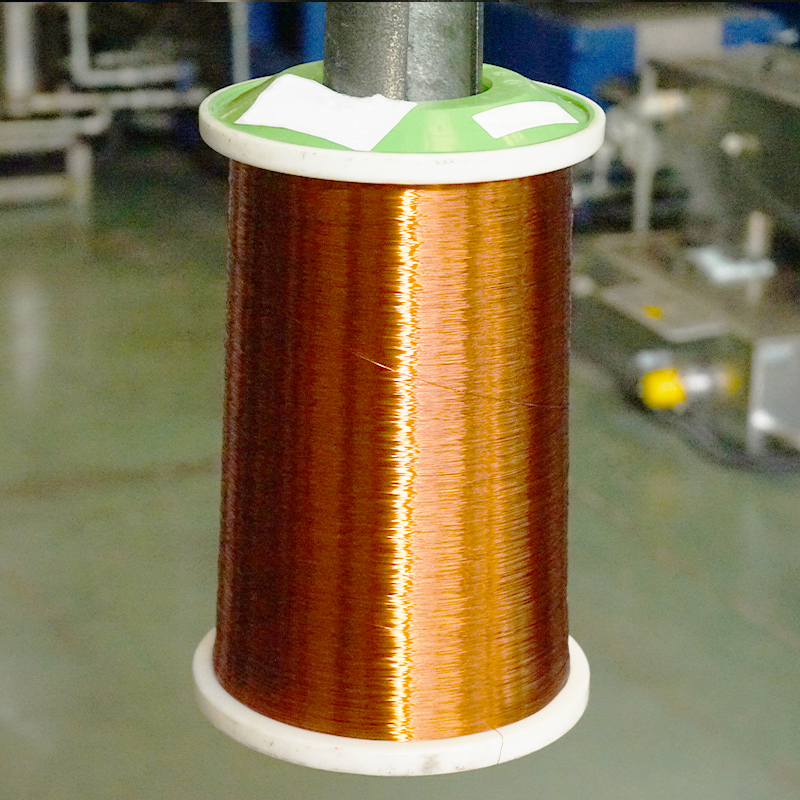
Jingda’s Class 240 Polyimide Enameled Round Copper Wire is an aromatic polyimide insulated round copper magnet wire manufactured to NEMA MW 16-C and IEC 60317-46, and is a UL Recognized Component. The snapshot below covers the selection-level essentials; the full dimensional and electrical data — conductor diameter and tolerance, film thickness, breakdown voltage, and resistance — sit in the datasheet, where an engineer reviewing a specification will want to read them in full.
| Attribute | Detail |
|---|---|
| Standards | NEMA MW 16-C · IEC 60317-46 |
| Thermal class | 240 (UL Recognized Component) |
| Conductor | High-purity copper, ≥ 99.95% Cu |
| Insulation system | Aromatic polyimide resin; Grade 1 (Single) / Grade 2 (Heavy) / Grade 3 (Triple, custom build) |
| Applicable diameter range | 0.250–1.500 mm |
IEC 60317-46 specifies Grade 1 and Grade 2; Grade 3 is supplied as a custom build.
Common Questions Engineers Ask Before Selecting Class 240 Magnet Wire
Why do suppliers list both MW 16-C and IEC 60317-46?
Because magnet wire is specified under different standards frameworks in different regions. MW 16-C is the North American ANSI/NEMA MW 1000 designation; IEC 60317-46 is the international IEC 60317 reference. For aromatic polyimide round copper wire they describe comparable specifications under different systems, so a supplier cites whichever framework its documentation follows — and often both, to serve engineers in different markets.
Does Class 240 mean the wire can continuously operate at 240 °C?
No. Class 240 is a thermal class built on a temperature index of 240, which classifies the insulation’s thermal endurance rather than fixing a service temperature. The degrees-Celsius figure behind the index is not automatically the temperature the wire should run at; the usable operating temperature depends on the equipment and the complete design.
When should engineers select Class 240 instead of Class 200?
When the winding’s thermal duty, hotspot temperature, insulation-system class, and reliability margin call for a higher-class insulation. The choice follows the design requirements and the surrounding insulation system, not the temperature reading alone — and a higher class is not automatically a drop-in upgrade.
What documents should engineers verify before approving magnet wire?
The standard reference and grade, the thermal-class basis, the dimensional and electrical data from the datasheet, and the conformance evidence the supplier cites. With these confirmed, cross-referencing designations like MW 16-C and IEC 60317-46 becomes a confirmation step rather than an assumption.
FAQ
Are MW 16-C and IEC 60317-46 the same standard?
No — they are two different standards. For aromatic polyimide insulated round copper magnet wire they describe comparable specifications under different standard systems: MW 16-C is the ANSI/NEMA MW 1000 designation, and IEC 60317-46 is the corresponding IEC 60317 part. Engineers cross-reference the two rather than treating one as automatically satisfying the other.
What does Class 240 mean for polyimide magnet wire?
Class 240 is a thermal class: the insulation carries a temperature index of 240, defined in the IEC system together with a heat-shock requirement. It classifies the insulation’s thermal endurance; it is not an operating-temperature guarantee.
Can Class 240 magnet wire replace Class 200 in a high-temperature winding?
It can be specified where the design calls for a higher thermal class, but “higher class” is not automatically a drop-in upgrade. A different enamel can behave differently in processing and termination, and the class must be consistent with the whole insulation system — so replacement is a design decision, not a default.
How do I cross-reference a supplier’s MW 16-C datasheet to IEC 60317-46?
Match on material and form first (aromatic polyimide, round copper), then map the type designations (MW 16-C ↔ IEC 60317-46) and confirm the grade/build. Because standard systems can label thermal class differently, verify the class against the applicable standard reference rather than assuming the labels are directly interchangeable.
Why do engineers compare MW 16-C with IEC 60317-46 when selecting magnet wire?
Because the two references come from different standards frameworks — MW 16-C from the North American ANSI/NEMA MW 1000 system, IEC 60317-46 from the international IEC 60317 system — and suppliers in different regions document to different ones. Comparing them lets an engineer confirm that datasheets from different sources describe comparable wire before those specifications go into a winding design.
What information should a Class 240 magnet wire datasheet include?
At minimum: the applicable standard reference and grade, the thermal-class basis (temperature index and how the class is stated), conductor dimensions with tolerances, film thickness, breakdown voltage, conductor resistance, and the conformance or certification references. The Jingda Class 240 datasheet sets out this data in full for specification review.
References & Standards
The technical statements in this article draw on the following standards and product documentation. Standards are referenced by designation; readers should consult the current published editions for the authoritative text.
- ANSI/NEMA MW 1000, Magnet Wire — NEMA designation system for magnet wire, including MW 16-C. National Electrical Manufacturers Association (nema.org).
- IEC 60317-46, Specifications for particular types of winding wires — Part 46: Aromatic polyimide enamelled round copper wire, class 240 — International Electrotechnical Commission (webstore.iec.ch).
- IEC 60317-0-1, Specifications for particular types of winding wires — Part 0-1: General requirements — Enameled round copper wire — conductor dimension basis referenced by IEC 60317-46.
- IEC 60172 — test method for the determination of the temperature index of enamelled winding wires.
- IEC 60851-6 — test methods for winding wires, thermal properties (heat shock, cut-through / softening breakdown).
- Jingda product specification and datasheet, Class 240 Polyimide Enameled Round Copper Wire (spec no. TLJD-QY01) — thermal-class, heat-shock, cut-through, dimensional and UL data cited in this article.
Thermal-class, heat-shock, cut-through and dimensional values stated for the Jingda product are taken from the Jingda product specification. Standard scope and designation information is summarized in the authors’ own words from the published standards above and should be verified against the current editions.
If your winding design needs confirmation of thermal class, standard reference, or the available wire specifications, the fastest next step is to review the technical datasheet — or discuss the application requirements with Jingda’s engineering team.
View the Technical Datasheet · Request Technical Support · Request a Sample