


Magnet Wire Insulation Types: Enamel Systems Compared
Magnet wire insulation type is the chemistry of the enamel film: polyurethane, polyester, polyester-imide, polyamide-imide or polyimide. The chemistry decides whether the wire can be soldered, which chemicals it tolerates and the thermal class it can reach.
This guide covers the enamel coating types Jingda supplies on round magnet wire: how datasheets name them, how they compare and how to choose one.
What “insulation type” means on a magnet wire datasheet
On a datasheet, insulation type names the enamel chemistry, and thermal class names the temperature rating that chemistry earned in thermal endurance testing. The two are linked but not interchangeable.
The thermal class belongs to a specific chemistry and construction, tested on a specific conductor. The same basecoat and topcoat chemistry, for example, is rated Class 200 on copper (NEMA MW 35-C) and Class 220 on aluminum (NEMA MW 35-A) in the Jingda range. A thicker film does not raise the class.
Datasheets usually identify the insulation type in three or four ways at once:
- IEC 60317 part number. IEC 60317 is the international specification series for particular types of winding wire. Each part covers one insulation system and one thermal class, so the part number alone tells you both.
- NEMA MW type. ANSI/NEMA MW 1000 is the North American magnet wire standard. Its Annex C cross-references MW type numbers to the corresponding IEC 60317 parts.
- JIS type code. JIS C 3202 uses short codes that name the chemistry directly: PEW (polyester), EIW (polyester-imide), AIW (polyamide-imide), PIW (polyimide) and UEW (polyurethane).
- Type designation. Chinese GB codes such as QZY-*/180 or QY-*/240 combine a chemistry code with the thermal class.
When two documents disagree, go back to the standard part number. This guide deals with chemistry. Thermal classes and their test basis are covered in our guide to magnet wire insulation class.
What the enamel film has to do
The enamel film does four jobs at once.
- Separate adjacent turns. Without the film, touching turns in a coil would short, and current would bypass the winding instead of following the conductor.
- Withstand voltage. The film’s dielectric properties and thickness set how much voltage the wire can take between turns before breakdown, including transient spikes.
- Survive winding. High-speed winding drags the wire over tooling and neighboring turns, so the film has to resist abrasion and stretching without cracking.
- Resist the environment. Moisture, varnishes, oils, refrigerants and cleaning agents all reach the film. How well a chemistry tolerates them is often what separates two insulation types that share a thermal class.
No single chemistry is best at all four. That is why several insulation types exist, and why overcoated constructions combine two of them.
The insulation systems Jingda supplies
Jingda supplies polyurethane, polyester, polyester-imide, dual-coat polyester-imide with a polyamide-imide overcoat, polyamide-imide and aromatic polyimide enamels, plus self-bonding and corona-resistant grades. Each system below follows the same order: chemistry, thermal class, solderability, typical use and standard designations.
Polyurethane (UEW): solderable, Class 155 and 180
Polyurethane enamel decomposes at soldering temperature, so coil terminations can be tinned without mechanically stripping the film. It is the usual choice when a coil has many terminations or the wire is too fine to strip reliably.
- Thermal classes: 155 and 180.
- Solderability: direct solderable. The exact solder-bath temperature and immersion time are stated in the product specification and depend on conductor size and film build.
- Typical applications: small motor coils, relays and solenoids, sensor coils and other magnetic coils.
- Standard designations: IEC 60317-20 (Class 155) and IEC 60317-51 (Class 180); NEMA MW 79-C (155) and MW 82-C (180); JIS UEW; type designations QA-*/155 and QA-*/180.
- Aluminum conductor: solderable grades are also offered on aluminum (NEMA MW 79-A and MW 82-A); see the product page for scope.
The trade-off is the thermal ceiling. Where a winding has to be rated above Class 180, a non-solderable system is needed. See our solderable magnet wire for available grades.
Polyester and polyester-imide (PEW / EIW): Class 155 and 180
Polyester (PEW) and polyester-imide (EIW) are single-coat enamels for general home-appliance motor and transformer windings. Modifying the polyester resin with imide groups raises the thermal class from 155 to 180 (Class H).
- Thermal classes: 155 for polyester, 180 for polyester-imide.
- Solderability: not direct solderable.
- Typical applications: general home-appliance motors and transformer coils; polyester is also used for magnetic coils.
- Standard designations: polyester to IEC 60317-3, NEMA MW 5-C, JIS PEW, type designation QZ-*/155; polyester-imide to IEC 60317-8, NEMA MW 30-C, JIS EIW, type designation QZY-*/180.
Polyester-imide is also the basecoat of the dual-coat 200-class system below. When a design needs more abrasion or chemical margin than a single coat gives, the overcoated version is the next step. Round copper grades in both systems are listed on our copper magnet wire page.
Polyester-imide with polyamide-imide overcoat (EI/AIW): Class 200 copper, Class 220 aluminum
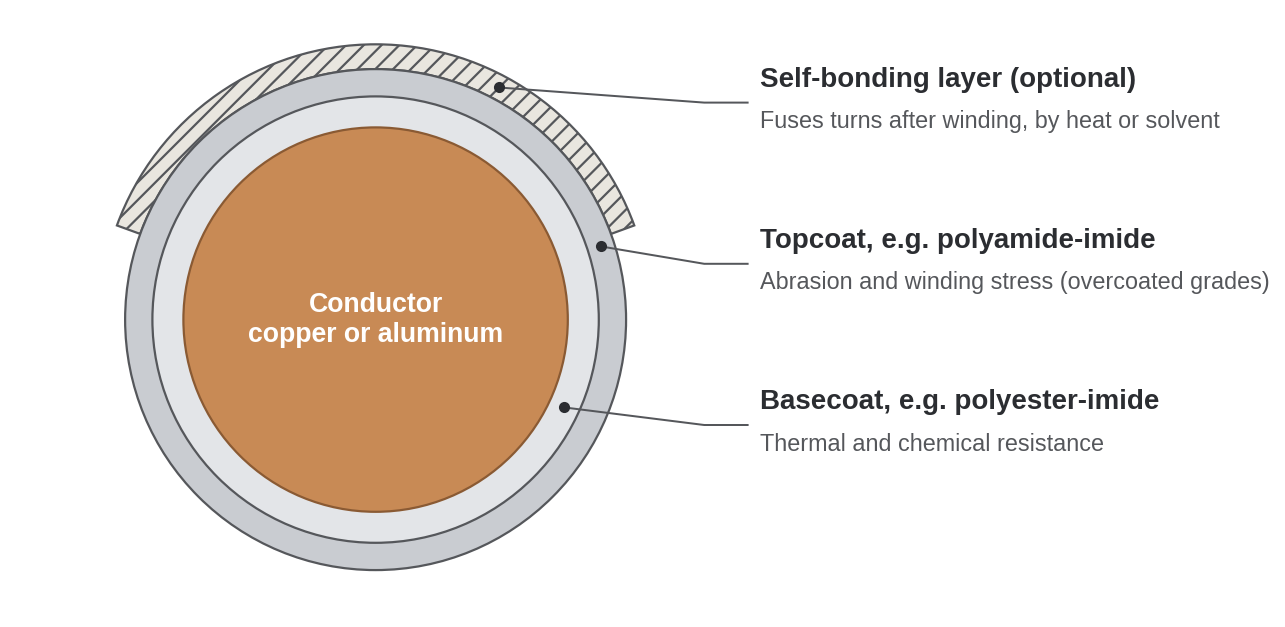
This dual-coat system uses a polyester or polyester-imide basecoat for thermal and chemical resistance and a polyamide-imide topcoat for abrasion and winding stress. In the Jingda range it is one of the most widely used high-temperature constructions.
- Thermal classes: 200 on copper; 220 on aluminum.
- Solderability: not direct solderable. Terminations are stripped mechanically or chemically.
- Chemical resistance: refrigerant resistance for hermetic compressor systems (copper) and refrigeration compressor windings (aluminum).
- Typical applications (copper, Class 200): hermetic compressors, power tool motors, automotive motors and water pump motors.
- Typical applications (aluminum, Class 220): refrigeration compressors, industrial motors, appliance motors and transformers.
- Standard designations, copper: IEC 60317-13; NEMA MW 35-C and MW 73-C; JIS EI/AIW; type designation Q(ZY/XY)-*/200.
- Standard designations, aluminum: NEMA MW 35-A and MW 73-A; JIS EI/AIW; type designation Q(ZY/XY)-*/220. Aluminum grades follow the general requirements of IEC 60317-0-3, with test methods per IEC 60851.
The lubricated polyamide-imide surface is what makes this construction suit automatic winders. Grade 1, 2 and 3 builds are available on the copper version. Specifications are on the 200 class enameled copper wire page and, for aluminum conductor, the aluminum magnet wire page.
Polyamide-imide (AIW): Class 220 copper
A single polyamide-imide enamel reaches Class 220 on copper. It is used where a winding needs more thermal margin than the dual-coat 200-class system but does not call for polyimide.
- Thermal class: 220.
- Standard designations: IEC 60317-57; NEMA MW 81-C; JIS AIW; type designation QXY-*/220.
- Properties: good heat resistance and good mechanical strength of the film.
- Typical applications: general industrial motors, open-type home-appliance motors and transformer coils.
- Solderability: not direct solderable. Chemical resistance: see datasheet.
Aromatic polyimide (PIW): Class 240
Aromatic polyimide is the highest-rated enamel in the Jingda range, at Class 240. It resists common solvents, but it is not designed for direct soldering through the film.
- Thermal class: 240.
- Solderability: not direct solderable.
- Chemical resistance: excellent resistance to common solvents.
- Typical applications: aerospace motors and actuators, smoke-extraction fans, high-temperature automotive motors and high-temperature sensors.
- Standard designations: IEC 60317-46; NEMA MW 16-C; JIS PIW; type designation QY-*/240.
See our polyimide magnet wire for sizes and builds.
Self-bonding overcoat
A self-bonding wire carries an extra bonding layer over its base insulation. After winding, heat or solvent activates the layer and fuses adjacent turns, so the coil holds its shape without a bobbin, tape or varnish impregnation.
- How it is used: the coil is wound, then bonded, typically by passing current through the winding, oven curing or solvent activation. The bonding method has to suit the bonding layer’s chemistry.
- Typical applications: automotive motors, power tools and motor coils. More generally, self-bonding wire suits any winding that must stay self-supporting after forming, such as air-core coils.
- Jingda grade: polyester-imide / polyamide-imide base (SBEIAIW), Class 200 (type designation Q(ZY/XY)N-*B/200), NEMA MW 102-C.
Self-bonding round copper grades are listed on our copper magnet wire page.
Corona-resistant and inverter-duty grades
Corona-resistant enamels are made for windings driven by inverters, where fast voltage rise times and overshoot at the motor terminals can cause partial discharge between turns. The enamel contains inorganic fillers that slow erosion when partial discharge occurs.
- When they are needed: when the peak voltage between turns, including inverter overshoot, can exceed the winding’s partial discharge inception voltage. Common cases are variable-frequency drives, electric vehicle traction motors and fast-switching power electronics.
- When they are not: mains-fed motors and transformers without fast switching transients rarely need them. A standard grade with an adequate build is usually sufficient.
- Jingda supply: two corona-resistant copper grades: polyamide-imide, Class 220 (type designation BP-*/220), and polyester-imide with a polyamide-imide overcoat, Class 200 (Q(ZY/XY)BP-*/200). Listed uses include new energy vehicle drive motors, wind power generators and industrial variable-frequency motors.
Partial discharge behavior depends on the whole insulation system, including slot liners, varnish and winding layout, so wire selection is one input to that evaluation.
Magnet wire insulation types compared
The table compares each insulation system by thermal class, direct solderability, solvent and refrigerant resistance, corona resistance, typical applications, type designation and standards. Values come from Jingda’s product pages and product documents.
| Insulation type | Thermal class | Direct solderable | Solvent / refrigerant resistance | Corona resistance | Typical applications | Type designation | Standards |
|---|---|---|---|---|---|---|---|
| Polyurethane (UEW) | 155, 180 | Yes | See datasheet | Standard grade | Small motor coils, relays, solenoids, sensor coils | QA-*/155, QA-*/180 | IEC 60317-20, -51 · NEMA MW 79-C, MW 82-C · JIS UEW |
| Polyester (PEW) | 155 | No | See datasheet | Standard grade | Home-appliance motors, transformer coils, magnetic coils | QZ-*/155 | IEC 60317-3 · NEMA MW 5-C · JIS PEW |
| Polyester-imide (EIW) | 180 | No | Common chemical performance | Standard grade | Home-appliance motors, transformer coils | QZY-*/180 | IEC 60317-8 · NEMA MW 30-C · JIS EIW |
| Polyester-imide + polyamide-imide overcoat, copper (EI/AIW) | 200 | No | Refrigerant resistance for hermetic compressors | Standard grade; corona-resistant grade listed | Hermetic compressors, power tool, automotive and water pump motors | Q(ZY/XY)-*/200 | IEC 60317-13 · NEMA MW 35-C, MW 73-C · JIS EI/AIW |
| Polyester-imide + polyamide-imide overcoat, aluminum (EI/AIW) | 220 | No | Refrigerant resistance for refrigeration compressors | Standard grade | Refrigeration compressors, industrial and appliance motors, transformers | Q(ZY/XY)-*/220 | NEMA MW 35-A, MW 73-A · JIS EI/AIW · IEC 60317-0-3, IEC 60851 |
| Polyamide-imide, copper (AIW) | 220 | No | See datasheet | Standard grade; corona-resistant grade listed | General industrial motors, open-type appliance motors, transformer coils | QXY-*/220 | IEC 60317-57 · NEMA MW 81-C · JIS AIW |
| Aromatic polyimide (PIW) | 240 | No | Excellent resistance to common solvents | Standard grade | Aerospace motors and actuators, smoke-extraction fans, high-temperature automotive motors and sensors | QY-*/240 | IEC 60317-46 · NEMA MW 16-C · JIS PIW |
| Self-bonding overcoat, polyester-imide / polyamide-imide base (SBEIAIW) | 200 | No | Excellent chemical performance | — | Automotive motors, power tools, motor coils | Q(ZY/XY)N-*B/200 | NEMA MW 102-C |
| Corona-resistant grades (copper) | 200, 220 | No | Good chemical performance | Yes | NEV drive motors, wind power generators, industrial variable-frequency motors | Q(ZY/XY)BP-*/200, BP-*/220 | — |
Read the table as a starting point. Grades within one insulation type differ in build, lubricant and test values; design against the product datasheet.
How to choose a magnet wire insulation type
Start from the application: its hot-spot temperature, how the coil is terminated and what chemicals the winding will meet. Then choose the insulation type that meets all three.
Wire thermal class is one input to system evaluation; the insulation system as a whole is evaluated separately.
| Application | What usually decides it | Insulation types to evaluate |
|---|---|---|
| Industrial motors | Hot-spot temperature, winding abrasion, varnish compatibility | Dual-coat EI/AIW (200 copper, 220 aluminum) or polyamide-imide (220); corona-resistant grade if inverter-fed |
| Hermetic and refrigeration compressors | Refrigerant and oil exposure | Dual-coat EI/AIW: 200 on copper, 220 on aluminum |
| Transformers | Thermal class of the insulation system, varnish or oil compatibility | Polyester (155), polyester-imide (180), polyamide-imide (220), dual-coat EI/AIW (220 aluminum) |
| Electronic coils, relays and sensors | Solder terminations, fine sizes | Polyurethane (155 or 180) |
| Electric vehicle and inverter-fed motors | Partial discharge, high thermal class | Corona-resistant grades (200, 220); dual-coat EI/AIW (200) or polyimide (240) for automotive motors |
| High-temperature equipment (aerospace, smoke extraction) | Hot-spot temperature above Class 220 | Aromatic polyimide (240) |
Industrial motors. In the Jingda range, the dual-coat EI/AIW system and single-coat polyamide-imide are the main candidates. For inverter-fed industrial motors, the corona-resistant grades apply. For OEM motor programs, see motor winding wire.
Compressors and home appliances. In hermetic compressors the film sits in refrigerant and oil for the life of the unit, so chemical resistance weighs as much as thermal class. See compressor winding wire.
Electronics. Fine coils with many terminations favor polyurethane, because each termination can be soldered without stripping. See fine magnet wire.
Electric vehicles. Traction motors combine high thermal class with inverter drive, so partial discharge is part of the insulation decision from the start. See electric motor wire.
Insulation build (Grade 1 / 2 / 3) vs insulation type
Build is how thick the enamel film is; insulation type is what the film is made of. Grade 1, 2 and 3 (Single, Heavy and Triple builds) increase film thickness but do not change the thermal class.
The two are often confused because both appear in the same line of a datasheet: for example, a Class 200 wire in Grade 2 build. The class comes from the chemistry. For each nominal conductor diameter, the standard sets the minimum increase in diameter due to the enamel and the maximum overall diameter for each grade.
A heavier build has costs as well as benefits. It raises breakdown voltage and partial discharge inception voltage, and it gives more tolerance to winding damage. It also increases overall diameter, which lowers how much conductor fits in a given slot or window. Jingda supplies Grade 1 to Grade 3 builds, with diameters specified in metric and AWG sizes.
Uniformity matters as much as thickness
A film is only as strong as its thinnest point. Variation in coating thickness, pinholes and poor adhesion to the conductor all create sites where breakdown starts early under electrical or thermal stress.
Multi-pass coating, in which the film is built up in several thin layers with a cure between passes, is the industry’s standard way to keep the film uniform. Inline high-voltage continuity testing then detects faults before the wire is spooled. Adhesion matters for the same reason: film that lifts during bending or thermal cycling leaves voids where discharge can start.
Frequently asked questions
What is the most common magnet wire insulation?
For home-appliance and general motor windings, polyester-imide (Class 180) and polyester-imide with a polyamide-imide overcoat (Class 200) are widely specified. Polyurethane is common where coils are terminated by soldering. The right choice depends on temperature, termination method and chemical exposure.
Can polyurethane magnet wire be soldered without stripping?
Yes. Polyurethane (UEW) enamel decomposes at soldering temperature, so terminations can be tinned directly without mechanical stripping. The solder-bath temperature and immersion time depend on conductor size and film build, and they are stated in the product specification.
What insulation class is polyimide magnet wire?
Jingda’s aromatic polyimide magnet wire is Class 240, to NEMA MW 16-C and IEC 60317-46 (JIS PIW). It is the highest thermal class in the range and is not designed for direct soldering.
What is the difference between insulation type and thermal class?
Insulation type is the enamel chemistry, such as polyurethane, polyester-imide or polyimide. Thermal class is the temperature rating that a specific chemistry and construction earned in thermal endurance testing. One names the material; the other names its tested temperature capability.
Does thicker enamel mean a higher thermal class?
No. Grade 1, 2 and 3 builds change film thickness, which affects breakdown voltage and mechanical margin. The thermal class is set by the enamel chemistry, so a Grade 3 build of a Class 180 wire is still Class 180.
Which magnet wire insulation types resist refrigerants?
The dual-coat polyester-imide and polyamide-imide system is specified for refrigerant exposure. Jingda supplies it as Class 200 on copper for hermetic compressors and as Class 220 on aluminum for refrigeration compressors.
When is corona-resistant magnet wire needed?
When a winding is inverter-fed and the peak voltage between turns, including switching overshoot, can exceed its partial discharge inception voltage. Typical cases are variable-frequency drives and electric vehicle traction motors. Mains-fed windings rarely need it.
How do I match an IEC 60317 part to a NEMA MW type?
Use Annex C of ANSI/NEMA MW 1000, which maps MW type numbers to the corresponding IEC 60317 parts. For example, MW 16-C corresponds to IEC 60317-46 (polyimide, Class 240), and MW 79-C corresponds to IEC 60317-20 (solderable polyurethane, Class 155).
Request a quote or a datasheet
Send us the insulation type, thermal class, conductor, diameter and build, and we will reply with a quotation within 1 business day. Minimum order quantity is 600 kg per specification, and FOB is the default term.
Datasheets are available through View Datasheet on the individual product pages. The full range is on our magnet wire page.
Tongling Jingda Special Magnet Wire Co., Ltd. has manufactured enameled wire since 1990 to IEC 60317, NEMA MW 1000 and JIS C 3202. UL Recognized constructions are available, and the UL status of a specific grade is confirmed on request. Production runs under an ISO 9001 quality system.
