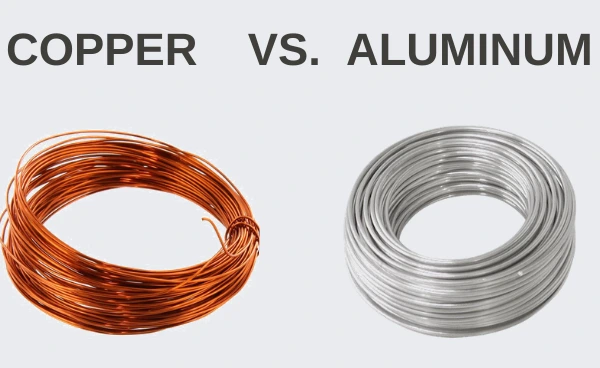
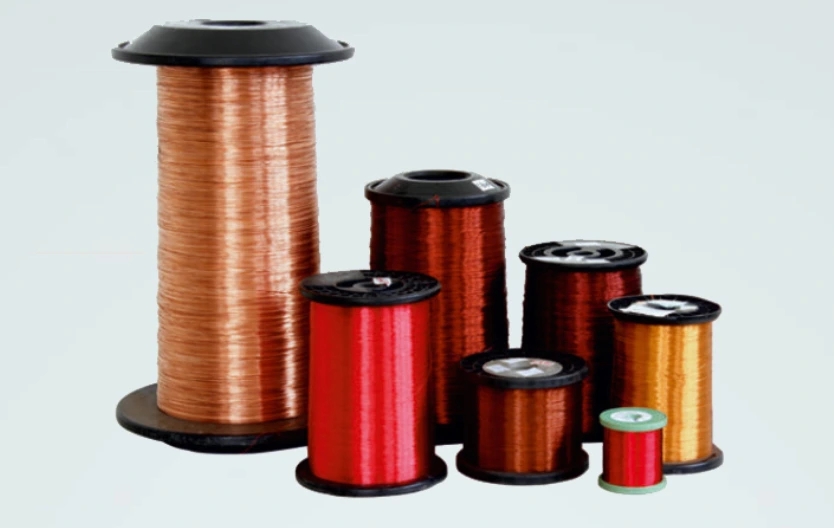
Copper vs aluminum motor windings should be compared as complete designs, not as equal-diameter conductors. Copper is often preferred when conductor area is limited or an existing motor has already been qualified around copper. Aluminum may be evaluated when lower conductor mass is important and the motor can accommodate a larger conductor area and the required design qualification.
The correct choice depends on seven connected factors: conductivity, required conductor area, conductor mass, slot and winding geometry, insulation system, standards coverage, and the motor or compressor operating environment.
Copper vs Aluminum Motor Windings: The Short Answer
Copper provides higher electrical conductivity for a given conductor cross-sectional area. Aluminum has a substantially lower density, but a larger aluminum cross-sectional area is required to obtain the same resistance over the same conductor length.
This means aluminum is not a drop-in, equal-diameter replacement for copper. Slot dimensions, conductor diameter, total winding resistance, turn count, insulation build, manufacturing requirements, and qualification requirements must be considered together.
| Selection factor | Copper winding | Aluminum winding | Engineering implication |
|---|---|---|---|
| Conductivity | Higher conductivity per unit cross-sectional area | Lower conductivity per unit cross-sectional area | Aluminum generally requires more conductor area for the same length and resistance |
| Conductor density | Higher density | Lower density | Aluminum can reduce conductor mass, but the complete winding must be recalculated |
| Required conductor area | Smaller area for a defined resistance and length | Larger area for the same resistance and length | Available slot area may influence the material decision |
| Existing motor design | Often suitable when the motor is already designed and qualified around copper | Usually requires design and process evaluation | Do not substitute materials based only on nominal wire diameter |
| Insulation system | Must match the required thermal, electrical, mechanical, and chemical conditions | Must match the required thermal, electrical, mechanical, and chemical conditions | Conductor material does not replace insulation-system qualification |
| Standards and recognition | Confirm the exact wire designation and model-level coverage | Confirm the exact wire designation and model-level coverage | A standard or UL file must not be extended to configurations outside its scope |
| Compressor use | Requires application and system-level qualification | Requires application and system-level qualification | Evaluate the specified refrigerant, lubricant, varnish, insulation, and process combination |
A practical copper vs aluminum motor windings decision should compare the complete electrical, dimensional, insulation, compliance, and application requirements.

1. Compare Conductivity Before Comparing Wire Diameter
Electrical conductivity is the starting point in a copper-versus-aluminum comparison, but it is not the final selection criterion.
The National Institute of Standards and Technology identifies annealed copper as the 100% International Annealed Copper Standard reference. Electrical-conductor-grade aluminum is commonly referenced at approximately 61.8% IACS.
Using these reference values, an aluminum conductor would require approximately 1.62 times the copper conductor area to achieve the same resistance over the same length and at the same reference temperature:
Reference conductor-area ratio: 100 ÷ 61.8 ≈ 1.62
This is a bounded material-property comparison, not a universal motor-design conversion rule. A real winding decision must also account for conductor tolerances, operating temperature, insulation build, slot dimensions, winding layout, total conductor length, electrical loading, and the motor’s existing qualification basis.
For this reason, copper and aluminum wires with the same nominal diameter should not be described as electrically equivalent.
2. Calculate the Required Conductor Area
When the target winding resistance and conductor length are fixed, aluminum’s lower conductivity normally requires a larger metallic cross-sectional area than copper.
This can affect:
- The selected bare conductor diameter
- The overall diameter after enamel application
- The number and arrangement of conductors that fit within the slot
- The available clearance and insulation space
- The feasibility of retaining an existing stator or winding configuration
- The qualification work required for a material change
If an existing motor has limited slot space, copper’s higher conductivity per unit area may make it the more practical starting point. Aluminum is more appropriately evaluated when the motor geometry can accommodate the required conductor area.
The design team should therefore compare complete winding proposals rather than equal-diameter wire samples.
3. Compare Conductor Mass at Equivalent Resistance
Density is one of aluminum’s important material differences. NIST reference data gives a density of approximately 8.89 g/cm³ for copper and approximately 2.703 g/cm³ for aluminum.
Combining the reference density values with the approximate 1.62 conductor-area ratio gives a theoretical aluminum-to-copper conductor mass ratio of about 0.49 for equal conductor length and resistance:
Reference conductor-mass ratio: 1.62 × 2.703 ÷ 8.89 ≈ 0.49
This calculation applies only to the conductor under the stated reference conditions. It does not mean that a complete aluminum-wound motor will automatically weigh 51% less.
The actual motor-level result depends on the winding design, insulation build, slot configuration, frame, laminations, connection system, and any other changes required to implement and qualify the design.
Use the calculation as an early material-screening reference, then verify the proposed construction through engineering review and prototype qualification.
4. Check Slot Space and Winding Geometry
Motor-winding material cannot be selected independently from the stator and coil geometry. A conductor that satisfies the electrical calculation must also fit the available winding space after its insulation build is included.
Before evaluating a change from copper to aluminum, review:
- Available slot area
- Bare conductor diameter
- Finished-wire diameter
- Required insulation build
- Turn count and conductor length
- Winding layout and coil geometry
- Clearance requirements
- The existing motor qualification basis
A design with little available slot area may favor copper because copper provides higher conductivity per unit area. A new or adaptable design may allow aluminum to be considered with an appropriately increased conductor area.
Slot fill should be verified using the actual finished-wire dimensions and the motor manufacturer’s design rules. It should not be estimated from conductor material alone.
5. Select the Insulation System and Thermal Class Separately
The conductor and the enamel insulation perform different functions. Copper or aluminum carries current, while the enamel provides electrical insulation and must withstand the specified thermal, mechanical, electrical, and chemical conditions.
A higher thermal class does not mean that every motor should use that class. Thermal class also does not, by itself, establish suitability for a particular motor or compressor. The selected wire must be evaluated as part of the complete insulation system.
Important selection questions include:
- What thermal class is required by the qualified motor or compressor design?
- Which enamel system and insulation build are specified?
- Which electrical, mechanical, thermal, and chemical tests apply?
- Does the requested conductor material fall within the declared specification?
- Is third-party recognition required for the exact wire configuration?
Jingda supplies enameled round copper wire and enameled round aluminum wire for industrial motor, compressor, coil, and component manufacturers.
Product selection should be based on the requested conductor, insulation system, thermal class, dimensions, applicable standards, and model-level requirements.
For a broader explanation of insulation systems, see Magnet Wire Insulation Types and Thermal Classes.
6. Verify Standards and UL Recognition at Model Level
Standards references should be checked against the exact product configuration. A NEMA magnet-wire designation, an IEC standard, and a UL Recognition are related specification tools, but they are not interchangeable.
- NEMA designation: Identifies a defined magnet-wire specification. The suffix “-C” denotes a copper conductor and “-A” denotes an aluminum conductor.
- IEC standard: Defines requirements and test methods for the applicable winding-wire construction.
- UL Recognition: Applies only to the material designations and configurations covered by the relevant UL file.
- Customer specification: May add dimensional, performance, application, or qualification requirements beyond the published standard.
Jingda’s 200-Class Enameled Round Copper Wire uses a dual-coat system and is specified through MW 35-C / MW 73-C and IEC 60317-13 routes. Selected configurations are UL Recognized under file E174580.
Jingda’s 220-Class Enameled Round Aluminum Wire includes MW 35-A / MW 73-A specification routes. Selected configurations are UL Recognized under file E248026.
These statements do not mean that every diameter, insulation build, material designation, or product sold within a broader product family has the same UL coverage.
Buyers should verify the exact model, conductor material, thermal class, size range, material designation, and applicable specification before approval.
For additional procurement guidance, see how buyers should verify model-level UL Recognition for enameled wire.
7. Separate General Motor Selection from Compressor Qualification
General motor and hermetic compressor applications should not be treated as identical design environments.
For a conventional motor, the material decision may begin with conductivity, conductor area, slot geometry, thermal class, insulation system, electrical requirements, and the existing qualification basis.
For a hermetic motor-compressor, the winding-wire configuration must also be evaluated within the complete application system. That system can include the specified refrigerant, lubricant, varnish or impregnation material, other insulation components, manufacturing process, and operating conditions.
A wire’s thermal class, NEMA designation, IEC reference, or UL Recognition should not be interpreted as universal approval for every refrigerant, lubricant, varnish, and compressor design.
Compressor manufacturers should define the qualification requirements for the exact application system. The winding-wire configuration can then be evaluated against those controlled requirements.
When Should You Choose Copper Motor Windings?
Copper is often the stronger starting point when:
- Available conductor or slot area is limited
- High conductivity per unit cross-sectional area is important
- The existing motor is already designed and qualified around copper
- A material change would require extensive redesign or requalification
- The customer specification requires an exact copper configuration
- The applicable IEC, NEMA, or UL route requires a verified copper construction
This does not mean copper is automatically the best choice for every motor. The decision still depends on the complete electrical, mechanical, thermal, manufacturing, compliance, and commercial requirements.
When Should You Evaluate Aluminum Motor Windings?
Aluminum may be worth evaluating when:
- Lower conductor mass is an important design objective
- The available geometry can accommodate the required conductor area
- The motor is being newly designed or can be requalified
- The production system can be validated for the selected aluminum wire
- The exact aluminum configuration meets the applicable dimensional and insulation requirements
- The required standard and recognition coverage can be verified
Aluminum should not be selected only from the raw-metal price. The engineering and purchasing review should consider finished-wire dimensions, redesign requirements, qualification work, manufacturing controls, quality requirements, and total program cost.
Copper vs Aluminum Motor Windings Decision Matrix
| Design condition | Likely starting point | Reason to investigate |
|---|---|---|
| Existing copper motor with restricted slot area | Copper | Changing to aluminum may require more conductor area and design requalification |
| New motor design with a conductor-mass objective | Evaluate aluminum | Lower conductor density may support the mass objective if sufficient area is available |
| Equal nominal wire diameter proposed as a direct substitution | Do not approve on diameter alone | Equal-diameter copper and aluminum conductors do not have equal resistance |
| Customer specification names an exact conductor and wire designation | Follow and verify the specified configuration | Material, construction, size, and recognition must match the qualification basis |
| Hermetic compressor application | Begin with system qualification requirements | The specified refrigerant, lubricant, varnish, insulation, and process combination must be evaluated |
| UL Recognition required | Verify the exact model-level coverage | A UL file number does not automatically cover every product within the family |
Information to Include in a Motor-Winding Wire RFQ
A technically complete RFQ helps the wire manufacturer identify an appropriate product route and resolve specification questions before sampling.
- Equipment type: motor or motor-compressor
- Motor type and operating environment
- Required conductor material, or confirmation that both materials may be evaluated
- Nominal bare conductor diameter or required size range
- Required finished-wire dimensions or insulation build
- Required thermal class
- Requested enamel or insulation system
- Applicable NEMA, IEC, UL, or customer specification
- Required UL material designation or file coverage, if applicable
- Prototype, sample, or qualification quantity
- Expected production volume and packaging requirements
- Customer drawings, acceptance criteria, and qualification requirements
For compressor projects, include the application’s controlled qualification requirements so that the proposed wire can be evaluated within the correct system.
How Jingda Supports Material Selection
For copper vs aluminum motor windings, Jingda reviews the requested conductor, dimensions, insulation system, thermal class, standard route, and qualification requirements before recommending a product pathway.
Available product pathways include:
- Enameled round copper wire
- Enameled round aluminum wire
- 200-Class Enameled Round Copper Wire with MW 35-C / MW 73-C and IEC 60317-13 specification routes
- 220-Class Enameled Round Aluminum Wire with MW 35-A / MW 73-A specification routes
Selection and compliance should be confirmed against the exact product designation, conductor size, insulation build, thermal class, customer specification, and third-party recognition requirements.
Request Material Selection Support and provide your motor type, conductor preference, wire dimensions, thermal class, applicable standard, qualification requirements, and expected volume.
Copper vs Aluminum Motor Windings FAQs
How should buyers compare copper vs aluminum motor windings?
Buyers should compare copper vs aluminum motor windings by required resistance, conductor length, conductor area, finished-wire dimensions, available slot space, insulation system, thermal class, applicable standards, and qualification requirements. Raw-metal price or equal nominal diameter should not be used as the only decision criterion.
Are aluminum motor windings equivalent to copper motor windings?
No. Aluminum has lower electrical conductivity per unit cross-sectional area than copper. An aluminum winding therefore normally requires a different conductor area and must be evaluated as part of the complete motor design. Equal-diameter copper and aluminum wires should not be treated as electrically equivalent.
How much larger does an aluminum conductor need to be?
Using reference conductivity values of 100% IACS for annealed copper and approximately 61.8% IACS for electrical-conductor-grade aluminum, the theoretical aluminum-to-copper area ratio is approximately 1.62 for the same conductor length and resistance at the same reference temperature.
This is a bounded material comparison, not a universal motor-design conversion factor.
Does an aluminum winding always make a motor lighter?
Aluminum has a much lower conductor density than copper, so it may reduce conductor mass. The final motor-weight change depends on the complete winding, slot geometry, insulation, frame, laminations, connections, and any design changes. It should be calculated for the actual motor.
Is aluminum always the lower-cost option?
No. Raw-metal price is only one part of the decision. Finished-wire requirements, conductor area, redesign, manufacturing controls, qualification, quality requirements, and total program cost must also be considered.
Can the same magnet wire be used in motors and hermetic compressors?
Suitability should not be assumed. A hermetic compressor requires evaluation of the exact winding-wire configuration within the specified refrigerant, lubricant, varnish, insulation system, production process, and operating conditions.
Does a UL file cover every Jingda copper or aluminum wire?
No. UL Recognition applies only to the material designations and configurations included within the relevant UL file. Buyers should verify the conductor material, model designation, thermal class, dimensions, and other applicable conditions at model level.
Sources and Technical References
- National Institute of Standards and Technology, Copper Wire Tables, NBS Circular 31. Reference data for annealed copper conductivity and density.
- National Institute of Standards and Technology, Aluminum Electrical Conductor Handbook, NBS Handbook 109. Reference data for electrical-conductor-grade aluminum conductivity and density.
- International Electrotechnical Commission, IEC 60317-13: Specifications for particular types of winding wires.
- International Electrotechnical Commission, IEC 60317-0-3: General requirements—Enamelled round aluminium wire.
- National Electrical Manufacturers Association, NEMA MW 1000: Magnet Wire. Reference for magnet-wire specifications, conductor suffixes, and cross-reference structure.
- UL Solutions Product iQ, Jingda UL file E174580. Coverage must be verified at material-designation and configuration level.
- UL Solutions Product iQ, Jingda UL file E248026, MW 35-A configurations.
- UL Solutions Product iQ, Jingda UL file E248026, MW 73-A configurations.